




AUTHOR: DICKENS, Charles.
TITLE: A Christmas Carol In Prose Being A Ghost Story of Christmas.
PUBLISHER: London: Chapman and Hall, 1843.
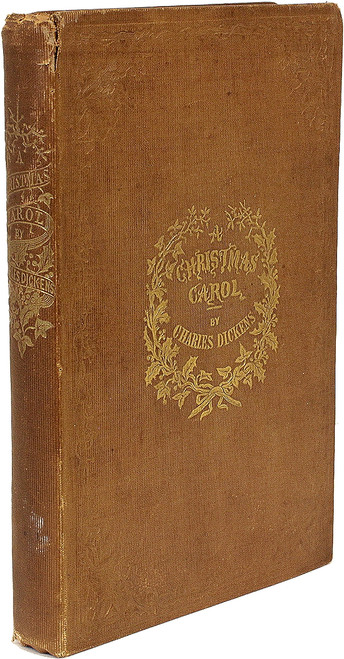
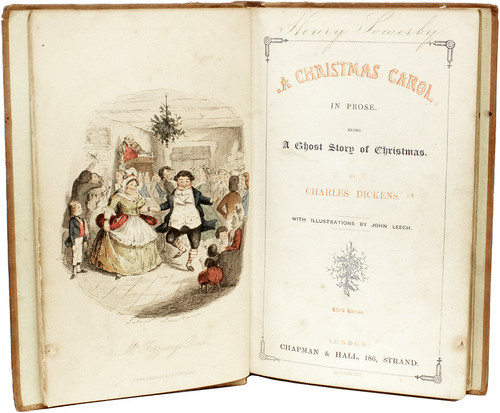
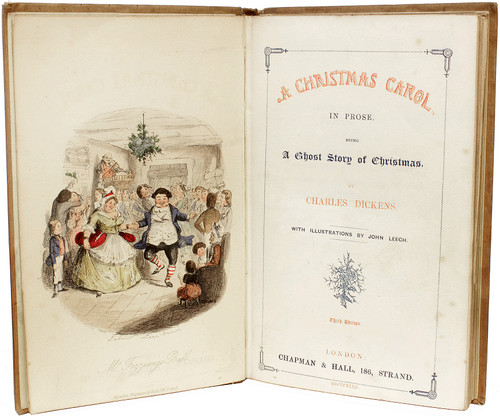
DESCRIPTION: THIRD EDITION. 1 vol., 6-5/8" x 4-7/16", illustrated with 4 hand colored engraved plates by John Leech and 4 black and white illustrations by W.J. Linton. Bound in the original straight grained rose colored cloth, gilt tile and wreath to spine and front cover, yellow pastedowns and endpapers, all edges gilt.
CONDITION: Back corners still square, head and foot of spine rubbed with some very minor loss, external hinges fine, spine and edges of cloth slightly sunned, front inner hinge starting, internally clean and bright, some signatures askew, completely unsophisticated, no bookplate, or former ownership inscription or markings, overall a GOOD+ copy.
ADDITIONAL INFORMATION: This was the last edition published in the same year as the original issue, which was done on Christmas eve. By the end of the next year (1844) 13 editions had been printed.
According to John Eckel, "A Christmas Carol" was published on December 19th, 1843 and sold 6,000 copies on the first day. Before the end of the year, eleven days later, it was in the third edition, with the combined number of copies of the second and third editions being estimated at only two to three thousand copies. This means that the second and third editions were at least two to three times scarcer than the first.
Regarded as Dicken's most widely read novel and considered to be "the greatest Christmas book ever written in any language" (Eckel p. 116) selling more than 6000 copies in the few days leading up to Christmas. The work was extravagantly costly as Dickens for the first time (and incidentally his last) used color in the title-page and etchings as he wanted to make the book a beautiful gift and to be a celebration of the Christmas spirit. After the initial success, Dickens continued the series throughout the 1840's, maintaining "the Carol" philosophy to "strike a sledgehammer blow" for the poor, uneducated, and repressed.

