

AUTHOR: SAND, George (pseudonym of Amantine Lucile Aurore Dupin de Francueil).
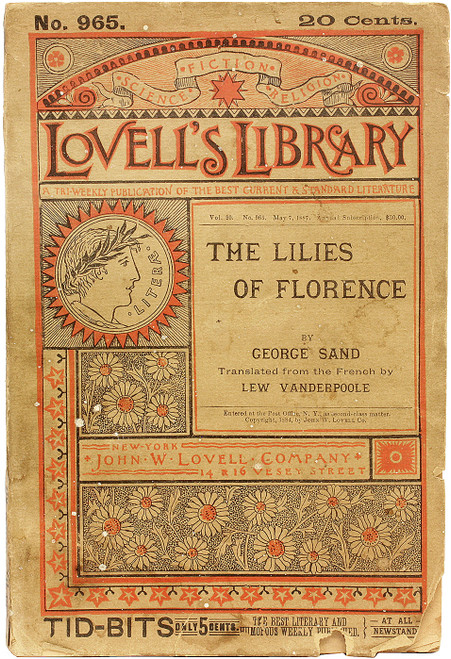
TITLE: The Lilies of Florence and Other Stories and Legends. Lovell's Library. Vol. 20. No. 965. May 7, 1887.
PUBLISHER: New York: John W. Lovell Company, 1887.
DESCRIPTION: FIRST EDITION. (i)217pp(ii), 7-1/16" x 4-3/4", bound in the publisher’s original decorative tan wrappers.
CONDITION: Hinges fine, minor chipping to head and foot of spine, some chipping to lower edge and outer corner of front cover, pages toned, general handling, overall still a GOOD+ copy of this exceedingly scarce work.
ADDITIONAL INFORMATION: No WorldCat listings for this edition, and only one (at OSU) for an 1897 edition by Munro 1890s printed from the same plates.
The translators preface, dated April 23, 1887, explains that this represents the first book publication, in any language of some of the 127 unpublished manuscripts that the author left behind at her death in 1876 (her translations had earlier appeared in several newspaper syndicates in the U.S. and U.K.) 'The bulk of her posthumous literary remains consists of short stories, legends, and psychological studies which, more than anything else, she always delighted in writing, though she rarely published anything less considerable than novels ... it comprises some of her best work.
This volume contains the title novella plus fifteen stories. All the material could be described as sensational or melodramatic. In addition, eight of the stories, as well as the novella, are based on supernatural motifs. Another story, "My Russian Rival," a tragic tale of a romantic triangle is noteworthy for off-handedly introducing a lesbian element into the story. This element is also found in "A Sprig of Sweet Briar," another tale of a tortured romantic triangle that ends in suicide, insanity and the vindication of Fate as Supreme Power. This moral is a keynote also of the title novella, which could serve as a textbook example of melodrama: the stock characters and plot elements, the thematic obsessing about which child is the offspring of which parent. The story begins with a premonitory dream by a five-year old boy, whose image of a year-old female infant in a bed of lilies nearby, is soon born out by events. A kind of shared dreaming also figures in the story. It ends where it began when, years later, the daughter of that discovered lily-girl is laid to rest there immediately joined by her grandfather, whose cause of death is remorse. Fate (or melodramatic plotting) casts its baleful glimmer over many of the other stories here. "The Himalayan Prisoner" also presents personality exchange and a curse of immortal solitary confinement for the magician who accomplished it. "A Cry in the Night" presents the aftermath of a deal with the devil, involving a beautiful 500-year-old woman in Venice. "An Etruscan Palace" brings justice to a villain through the mechanism of a magically powerful violin that conjures up images of his crimes and scares him to death. In "Lamia" we meet the Biblical Lilith, whose soul is redeemed through the love of a mortal she rescued from a wounded lion in Africa. "In Vintage Time" presents an enigmatic tale of class conflict, the struggle between pride and love, a hint of a survival or revival of paganism - and the ever-present tyranny of Fate. "Sea Voices" is perhaps the most effective weird horror tale in the collection: compact and inexorable. It uses plot and imagery elements found in some of the other stories: the seduced and abandoned woman, helpless infants, sudden death, menacing bodies of water, providential retribution. The author, who flourished around the middle of the 19th century, was noted for her advocacy of sexual liberty for women as well as men, but the stories in this collection almost hysterically proclaim the virtues of virginity and wedlock. Her novel, The Naiad, listed in some fantasy bibliographies, is a rationalized ghost story. But Laura (1865), a hollow earth fantastic adventure, was recently translated into English.
